Search This Blog

Powered by Blogger.

Translate

There's a 'Desert' in The Middle of The Pacific. Here's What Lives There

In the centre of the South Pacific, there's a place as far away from land as anyone on Earth could ever hope to get. The ocean is different there.

These distant waters lie at the heart of the South Pacific Gyre, the centre of which holds the 'oceanic pole of inaccessibility': the ocean's remotest extreme, aka Point Nemo (a name meaning 'no-one'), famous otherwise for being a spacecraft cemetery.

But aside from the ghosts of burnt-up satellites, what dwells under these far-off waves?

Not much, scientists have long thought. Despite taking up 10 percent of the ocean's surface, the South Pacific Gyre (SPG) – the largest of Earth's five giant ocean-spanning current systems – is generally considered a 'desert' in terms of marine biology.

Nonetheless, stuff does live there, even if organic life in these waters (and the seabed below it) is few and far between, due to a range of factors.

These include distance from land (and the nutrient matter it provides), the way water swirling currents isolate the centre of the gyre from the rest of the ocean, and high UV levels in this part of the ocean.

In truth, though, we don't actually know all that much about the life-forms that inhabit the SPG, largely because of how hard it is to study this oceanic desert – due to both its extreme remoteness, and also how large it is, covering about 37 million square kilometres (14 million square miles).

Despite the challenges, a recent international research effort has given us what the scientists claim is an unparalleled glimpse at the microbial creatures that exist in these waters.

During a six-week expedition aboard the German research vessel FS Sonne from December 2015 to January 2016, a crew led by the Max Planck Institute for Marine Microbiology sailed a 7,000-kilometre (4,350 miles) journey through the SPG from Chile to New Zealand.

En route, they sampled the microbial populations of the remote waters at depths between 20 to 5,000 metres (65 ft to 16,400 ft), using a newly developed analysis system that enabled the researchers to sequence and identify organic samples en route in as little as 35 hours.
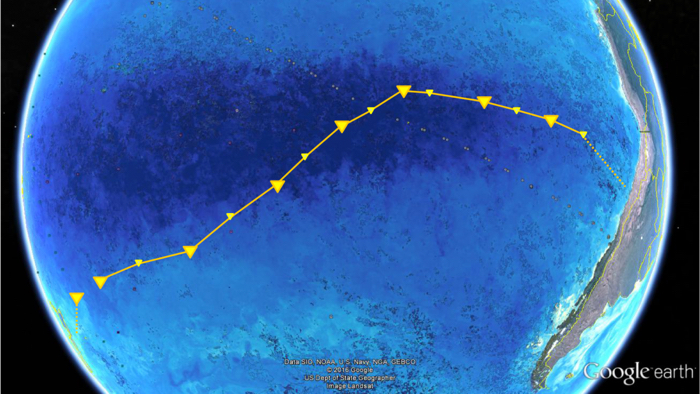
016 south pacific gyre 1 (Max Planck Institute for Marine Microbiology/Google Earth/NASA)

Above: FS Sonne's path crossing the SPG from Chile to New Zealand.

"To our surprise, we found about a third less cells in South Pacific surface waters compared to ocean gyres in the Atlantic", said one of the researchers, microbial ecologist Bernhard Fuchs, back in July 2019.

"It was probably the lowest cell numbers ever measured in oceanic surface waters."

Among the microbes the team found, 20 major bacterial clades dominated the lot. These were mostly organisms scientists have encountered in other gyre systems, such as SAR11, SAR116, SAR86, Prochlorococcus, and more.

The distribution of these microbe communities depended largely on water depth, based around factors such as changes in temperature, nutrient concentrations, and availability of light.

One of the populations identified, called AEGEAN–169, was particularly numerous in the surface waters of the SPG, whereas previous research had only discovered them at 500-metre depths.

"This indicates an interesting potential adaptation to ultraoligotrophic [low in biological productivity] waters and high solar irradiance", said one of the team, microbiologist Greta Reintjes.

"It is definitely something we will investigate further."

On the whole though, the sampling generally confirmed that the SPG is a "unique, ultraoligotrophic habitat", where low nutrient availability restricts growth to specialist oligotrophic organisms and creatures that have adapted to "extreme physicochemical conditions".

In other words, the SPG can't shake off its 'desert' reputation just yet, but there is a bright side to all that organic absence: these distant, almost lifeless waters are said to be the clearest ocean in all the world.

The findings were reported in Environmental Microbiology.

A version of this article was first published in July 2019.


Source: https://www.sciencealert.com

[TC] Google Glass in Helmet Form

A Motorcyclist's Dream: Google Glass in Helmet Form


Using high-tech dashboards, drivers can reference navigation systems and voice control in the comfort of a quiet car, but motorcyclists still don't have an effective, high-tech solution. Referencing maps requires a roadside stop, and GPS systems can be distracting.
Now, the team at LiveMap is looking to fund a project that would bring built-in navigation and augmented reality to helmets. Think Google Glass in helmet form.
The motorycle helmet, which is currently listed on crowdfunding site Indiegogo, comes with technology and features so powerful only fighter pilots currently have access. The project already has the financial backing and support from the Moscow Department of Science and several other Russian organizations, but LiveMap is looking for additional funding to get it up and running.
Similar to F-35 fighter jet helmets, a colorful, translucent picture would project onto the visor and create a clear, unobstructed view. It would come with its own interface — not iOS or Android — and prevent users from watching videos or playing games while riding.

For long drives, the motorcycle helmet features two 3000-mAh batteries, a microphone for voice control that keeps both hands focused on driving and a digital compass for head movement tracking. In case a motorcyclist runs into trouble, the command "help" will notify local authorities.
LiveMap plans to ship the helmet in August 2014, with a price tag of $1,500 for devices purchased in June and $2000 for those purchased afterward. If you don't want to fully invest in the technology but still want to give it a try, you can donate $100 to the fund to try on a head set at an upcoming LiveMap promo party in the future.


Helmet


[Tc] Google To Use 'Wireless Balloons' To Deliver Wi-Fi

Google will reportedly use Air balloons and satellites to provide Internet access to under-served countries. 

It is interesting that Google is planning to build wireless networks around the world in emerging markets such as Africa and Asia, but what’s more interesting is how the web giant plans to deploy this plan. The company is actually planning to offer Wi-Fi in these areas by using balloons. Yes, you heard us right! Not through the conventional cable strings but rather via flying balloons. 


Google, Google wi-fi, Google internet, Google services


As reported by the Wall Street Journal, Google is also supposedly planning to explore experimental methods to provide wireless connection to previously under served areas. These methods will include satellite Internet and the all new balloons plan, which will allegedly use high-altitude devices to blast wireless signals across hundreds of square miles.

This means that these aren’t just the conventional Wi-Fi routers tied on to the weather balloons. The devices will use different frequencies than those of television broadcasts.

So why is Google investing so much in hardware and engineering for underdeveloped areas? The Wall Street Journal in its report says that Google is just interested in increasing the user base into the Google sphere of apps and devices. This will in turn help Google to achieve considerable success in online advertising.

Way to go Google, you are doing some philanthropy too!


Page Rank

google pagerank

Write For Us

Submit a Guest Post

Find us on Facebook

Categories

555 Timer IC 7 segment Display 8051 Project AC Circuits Adafruit Alarms Amplifier Circuits Analog Circuits android Arduino arm processor Assembly Languange Atmel Atom Size Audio Circuits augmented reality Automotive Circuits avr Battery Circuits Bicycle Gurad bluetooth Cable TV Circuits Cambridge University Camera Technology Circuit Boards Clipping And Clamping Circuits Clocking And Timer Circuits Computing contact lens Contact Us Form Contests Controller Circuit Conversion Circuits Counter Circuits Digital Electronics diy circuits Downloads EFY EFYTimes Electronic Books Electronic Components Electronic Locks And Keys Engineering Fan Circuits Filter Circuits Fire Alarm free Frequency Fun And Game Circuits future Google Hack n Mod Ham Radio Circuits heart rate monitoring High Voltage Circuits Home Circuits IC Guide ieee Industrial Circuits Infrared Instructables Inventions ipad lcd Led Circuits Light Related Lighting Circuits Medical Circuits Meter Clocks Microcontrollers Microprocessors Mini Projects modules Movie maker NatGeo Navigation Notice Optical Fiber PC Circuits PCB Boards Physics pnp transistor Power Supplies Printing Projects Programmer Project Ideas Projectors Protection circuits Proximity Detectors Radar Radio Circuits Radio Transmitters Raspberry Raspberry Pie Remote Circuits Retis Lab RFID Robot Cars Robotics Science Science Alert Security And Safety Sensor Circuits Servo Motors Smallest Smartwatches sms Software solar cell sound application Spectram Switch Technology News Telephone Related Television Related Test And Measurement Circuits Thermal Projects Tone generator circuits Touch Screen Tutorials Wearables Wi-Fi Wireless
Like us on Facebook
Follow us on Twitter
Recommend us on Google Plus
Subscribe me on RSS